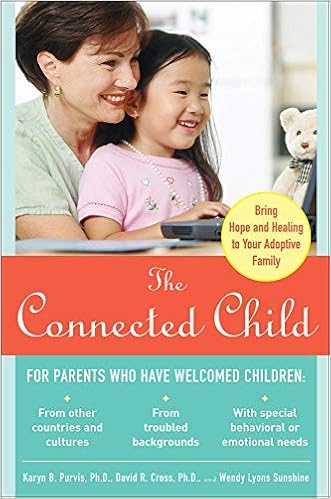
The Connected Child: Bring Hope and Healing to Your Adoptive Family
"An extremely useful parenting handbook... truly outstanding ... strongly recommended."
--Library Journal (starred review)
"A tremendous resource for parents and professionals alike."
--Thomas Atwood, president and CEO, National Council for Adoption
The adoption of a child is always a joyous moment in the life of a family. Some adoptions, though, present unique challenges. Welcoming these children into your family--and addressing their special needs--requires care, consideration, and compassion.
Written by two research psychologists specializing in adoption and attachment, The Connected Child will help you:
- Build bonds of affection and trust with your adopted child
- Effectively deal with any learning or behavioral disorders
- Discipline your child with love without making him or her feel threatened
"A must-read not only for adoptive parents, but for all families striving to correct and connect with their children."
--Carol S. Kranowitz, author of The Out-of-Sync Child
"Drs. Purvis and Cross have thrown a life preserver not only to those just entering uncharted waters, but also to those struggling to stay afloat."
--Kathleen E. Morris, editor of S. I. Focus magazine
"Truly an exceptional, innovative work . . . compassionate, accessible, and founded on a breadth of scientific knowledge and clinical expertise."
--Susan Livingston Smith, program director, Evan B. Donaldson Adoption Institute
"The Connected Child is the literary equivalent of an airline oxygen mask and instructions: place the mask over your own face first, then over the nose of your child. This book first assists the parent, saying, in effect, 'Calm down, you're not the first mom or dad in the world to face this hurdle, breathe deeply, then follow these simple steps.' The sense of not facing these issues alone--the relief that your child's behavior is not off the charts--is hugely comforting. Other children have behaved this way; other parents have responded thusly; welcome to the community of therapeutic and joyful adoptive families."
--Melissa Fay Greene, author of There is No Me Without You: One Woman's Odyssey to Rescue Africa's Children
Reviews (188)

Great Parenting Techniques, Terrible Generalizations
Dr. Purvis spent much of her life studying and working with adopted children from many walks of life. In her book "The Connected Child" she makes gross generalizations for ALL adopted children stating that they are ALL "at risk" and therefore all will act out. As I have read this book, I can see the behaviors she describes in many children, biological or adopted. In fact, as I reflect on my childhood, I see many of the behaviors in myself. The parenting techniques that Dr. Purvis offers are great and often work very well. The techniques don't include screaming and yelling, solitary punishment, or physical punishment. The techniques are focused on redirection and correction of the behaviors. It gives you techniques on how to train a child to control their behaviors and express how they are feeling. It gives insights on how to help your child make decisions by giving them choices. It gives you tools to use to help kids to stop and think about what they have just done wrong, and how to do it right. If you can read past the generalizations of "at risk" adopted children, the parenting techniques and tools provided in this book are great and I think any parent, of biological children or adopted, can benefit from the lessons.

THE Foster/Adopt Parenting Textbook (Buy it Now)
This is the textbook for foster (and fost-to-adopt) parents. If you do not have it yet, stop reading reviews now and buy it on your tablet or Kindle or audible so you can read it immediately. If you have friends or family new to fostering, buy them this book now. This book should be given to every foster parent upon completion of training or during training. It's a shame they mention the book, the author, and the research during training but not simply hand out the book as your reference Bible for the tough times sure to come. I wish we had this book when we had our first placement. He had been through hell and his behaviors were beyond our comprehension. Within the first few pages of the book is a table that connects behaviors to feelings that should be passed out to every foster parent before a child moves in.

Required reading but really slight value
Well, our second international adoption and the adoption agency requires this reading. I went in with an open mind but like most things I am ready to critique if the value is not there. Like most books written by those with PhD's, a lot of long winded repetitive talking on same subject matter just to hear themselves talk and seem intelligent. The author even cites several times from readers how "she" was so instrumental in assisting them through this book. I am not going to say one way or the other if it did indeed help but when you call out the parade on yourself I find the lack of humility to be quite distasteful. Just make a note in the beginning or end of the book that from feedback this book was said to be helpful to some readers and be done. But to cite your name even if truly was said by a reader seems quite pretentious. Like I said, a lot of repetitive subject matter on children from orphanages and how to deal with them. I really am not trying to take anything away from the books author but it could have quite possibly been written in 100 pages tops rather than going on and on. Some here I know will disagree with me but we are all entitled to our own summation of the quality of the product. Two stars...….reason being, I found a few interesting points, but most like stated just beat that dead horse a little more.

An Invaluable Read
Was this book really only $6.74?! I have a decent foundation in child development and managing "normal" behavior, but I read this book in preparation for becoming a foster parent to kids who have experienced trauma. This is an absolutely fabulous book on basic parenting, with very specific instructions for how to work with troubled children. I love it and I know I am going to be structuring our home life around what I've learned from this book.

Good for any parent to read!
This was a very helpful book! We are in the process of adoption, and it was recommended to us to read this book. We have listened to Dr. Purvis in the past and learned so much for her approach. This book will be kept within handy reach. She has so many wonderful ideas for how to interact with a child coming from a traumatic background. It is helpful for any child, not just a foster or adopted child!

It gives ideas on how to approach a difficult child with love and understanding
This book is about attachment parenting or caregiving to children who have come through difficult situations. It gives ideas on how to approach a difficult child with love and understanding. I will keep this book as a companion to my baby book on attachment parenting called Christian Parenting and Childcare by Dr. William Sears. This particular book does NOT use scripture but it is scriptural in its teaching. Good for foster children, adoptive children from other cultures and children who have been in violent or emotionally abusive homes.

Highly Recommended to Me - and I Recommend to You
This book was recommended to me by my adoption caseworker and by other adoptive moms in a public forum. I strongly recommend it! We are about to adopt siblings and, even though they don't have any current behavior concerns like hoarding or RAD, this book has still been helpful in parenting any children who have experienced trauma. The book has lots of examples and lots of specific ways to help connect and support your children. I'm about halfway through the book now (I read half and then re-read half with a pencil, making notes and underling parts I wanted to remember) and the chapters on "Felt Safety" and "Teaching Life Values" have been the most helpful so far - well, that our struggles are not ours alone - others have had them and many have surpassed them. Karyn Purvis is an expert in the field - and after reading this book, I understand why her name is so well known. Her work is realistic, down to earth, and filled with hope. If you are adopting or work with foster or adopted children, this is a great read. The book's main points are: - The key is to treat the whole child - and we'll help you do that! - Start where your child is - Compassion is key - Focus on nurturing and structure / connecting and correcting - "At-risk youngsters are capable of making tremendous strides toward overcoming early hardships and limitations."

A lifesaver
I was afraid the book would tell me to just be more patient and understanding, because I was so maxed out and stressed with the constant screaming and fits. To my utter relief, there are strategies that WORK. My little guy is 2, so I can't speak for older kids and kids from different situations, but these strategies produced IMMEDIATE results!! We still have a long way to go. The behaviors haven't stopped, but they are much less frequent and shorter in duration. Hallelujah!! I'm also using these things with my other kids. I've changed the way I treat my 11 year old by offering more eye contact. My other two year old used to cry at nights, repeatedly. Now, I use one of the phrases the book gave me and we can resolve whatever it is and she doesn't cry again. Wow! I think every parent would LOVE this book.

Exactly What our Family Needed
After floundering for the past year trying to parent our boys in a traditional way, we were introduced to TBRI and this book. Karyn and David are compassionate, thoughtful, patient and have research that backs up this method. We have been using TBRI for several months and it is doing wonders for both my husband and myself, and our boys. If you have children from hard places, trauma, or even if you're looking for a new, connected way to parent your children that do not come from trauma, I highly recommend this book. I plan on reading it again and again.

For more extreme behavioral challenges
This gave step by step instructions for situations that are pretty severe. Like what to do and say after you find your child throwing wooden blocks at another child on purpose. When I follow the guidelines described here and it doesn't work, I still feel like I knew what to do. Some situations will still leave your child melting down on the floor, but now I have five good things to try first and you can start over again when your child can hear you. You can't always control the child. You can only control what you do, so if you stay calm and following a series of steps then you have succeeded. You can't judge yourself by results alone. I have learned that the hard way. To feel good about myself I needed to feel like I was successfully applying the behavioral advice found in this book. Good luck!


Comments
Post a Comment